In modern biomimetic dentistry, Porcelain Inlays and Onlays (often called Partial Crowns) serve as the ultimate conservative alternative. At Jet Dentist, we harness 3D Intraoral Scanning and high-precision CAD/CAM milling to craft custom E.max® porcelain inserts that fit your tooth like a missing puzzle piece—restoring 100% masticatory strength while preserving your natural tooth structure.
Inlay vs. Onlay: What Is the Clinical Difference?
Both inlays and onlays are indirect restorations fabricated in a specialized dental laboratory before being permanently bonded to your tooth. The key clinical distinction lies in the extent of coverage:
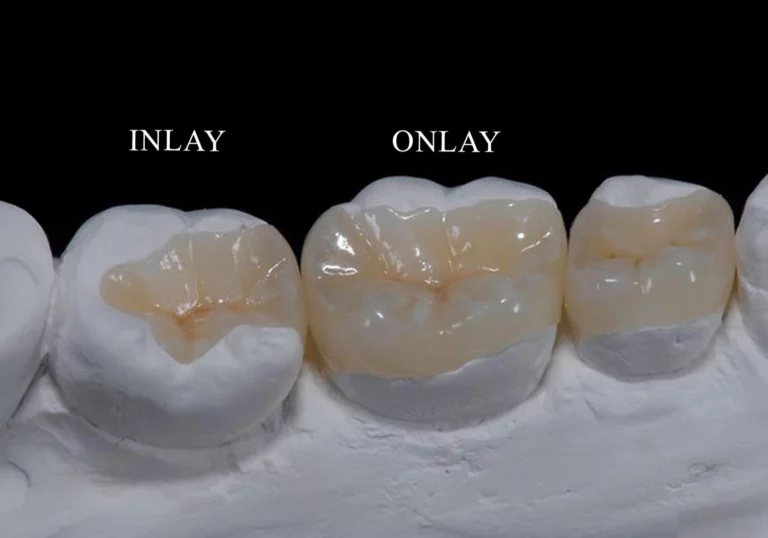
- Porcelain Inlays: Designed to repair damage within the cusps (bumps) of the biting surface. An inlay replaces internal tooth structure destroyed by deep cavities or failing amalgams.
- Porcelain Onlays: Recommended when damage extends over one or more cusps of the tooth. Because an onlay covers the biting points, it protects the tooth against vertical fractures under heavy chewing pressure, earning it the title of “Partial Crown.”
The Benefits of the Conservative Approach
Superior Fit: They offer a conservative preparation that preserves as much healthy tooth as possible. They are a great choice if you have minimal to moderate tooth decay that extends into a flossing area, offering an excellent alternative to full coverage crowns.
Tooth Color: Boasting esthetic longevity, they are not likely to discolor over time as tooth-colored resin fillings often do.
Tooth Structure Safeguard: They preserve the maximum amount of healthy tooth structure while restoring decayed or damaged areas, helping to ensure functional longevity.
Easy Tooth Cleaning: Because the fit is tailored at all edges and the preparation minimal, your tooth can be easier to clean than it would be with full coverage restorative alternatives such as a dental crown. Composite fillings can shrink during the curing process, whereas prefabricated porcelain or gold inlays/onlays will not (ensuring a precise fit).
Tight Space Fulfillments: If you have a cavity between your teeth, consider an inlay rather than a direct composite filling. They are better at sealing teeth to keep out bacteria; they are easy to clean, will not stain and offer exceptional longevity.
Strength and Stability: They are extremely stable restorative solutions for the treatment of decay. The superior fit and durable material make them a stable choice that can actually strengthen a damaged tooth.
Weak Tooth Protector: An onlay can protect the weak areas of the tooth. The procedure does not require the complete reshaping of the tooth.
The Procedure
Typically, an inlay or onlay procedure is completed in two dental visits.
During your first visit, your dentist must prepare the damaged tooth. A molded impression of the tooth is then taken and sent to a dental laboratory, where the restoration is fabricated.
Inlays and onlays can be made from gold, porcelain or resin materials. The difference is in the appearance of the finished restoration. A fitted, provisional restoration (sometimes known as a temporary or “temp” for short) in the shape of the final restoration can be created during this visit to protect the tooth while the final restoration is being fabricated.
Your dentist might discuss with you the best type of material to use. If esthetics is not a concern (for example, with back molars), gold is the best option. Porcelain offers the best esthetics and are often used in the “smile line” areas. Resin materials may be the best option for people who grind their teeth and/or those with a misaligned bite (malocclusion).
During your second visit, the provisional temporary is removed and your inlay or onlay is placed.
They are extremely stable restorations that seldom fail. Your dentist will check all margins to ensure a smooth fit with tight adjacent contacts. Your dentist will also check your bite to ensure that there are no occlusion-related problems affecting the margins of the restoration. Once fitted, the restoration is bonded onto the tooth and the margins are polished.
What Does the Future Hold?
The materials used to fabricate inlays and onlays continue to evolve and become more natural and tooth-like in terms of structure, how they wear and their longevity. Their use for restorative purposes is not likely to be replaced by another treatment any time soon due to the combination of excellent functional longevity and esthetic naturalness associated with inlays and onlays. In fact, maintaining tooth color over the course of your lifetime may be further enhanced as the materials continue to improve, adding to the esthetic value of the restoration.
Frequently asked questions
Why choose an Inlay/Onlay over a cheaper Composite Filling?
Large composite fillings shrink during light curing, creating micro-gaps that lead to recurrent decay within 3–5 years. In contrast, custom E.max® porcelain Inlays/Onlays do not shrink, match natural enamel strength, resist staining, and routinely last 10–15+ years—making them a superior long-term investment.
Can an Inlay or Onlay be completed in a single visit?
Yes. Thanks to our in-house CAD/CAM digital lab, single-unit inlays/onlays can be completed in a same-day 4-to-6-hour express session. However, for optimal shade glazing and stress-free ceramic cooling, we usually recommend a relaxed 2-visit workflow spread across 48 hours.
Is the procedure painful, and will my teeth feel sensitive afterward ?
The entire procedure is performed under gentle local anesthesia, ensuring zero pain. Because inlays and onlays preserve most of your natural tooth structure, nerve trauma is minimal. Any mild, temporary temperature sensitivity usually resolves within 24–48 hours.
What happens if my Onlay chips or comes loose in the future?
Loose restorations are extremely rare thanks to our 7th-gen bonding adhesive. If damage occurs, the loose piece can be easily removed without harming your remaining natural tooth. We can simply re-scan your tooth for a new onlay.
Other treatments
Explore our full range of treatments
Reviews
Read what our patients say about their experience